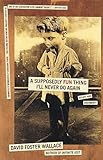
While working on an essay, I found myself needing to use a word that meant “related to the study of proper names.” I knew exactly the word I wanted, because I’d just come across the same usage while re-reading David Foster Wallace’s A Supposedly Fun Thing I’ll Never Do Again. In the essay on tennis player Michael Joyce, Wallace has this really cool throw-away paragraph about how the Association of Tennis Professionals’ weekly world rankings “constitute a nomological orgy that makes for truly first-rate bathroom reading.” He goes on to celebrate such names as Mahesh Bhupathi, Jonathan Venison, Cyris Suk (!), Leander Paes, Udo Riglewski, and Martin Zumpft — and that’s just like a fifth of them. It truly is good reading.
Except it isn’t “nomological.” That was the word I went looking for, but I found this definition of it instead: “relating to or denoting certain principles, such as laws of nature, that are neither logically necessary nor theoretically explicable, but are simply taken as true.” For instance, the idea that two parallel lines will run forever and never touch is nomological, at least within Euclidean geometry.
But that really doesn’t sound like what Wallace was trying to say. It’s pretty clear he meant to say “the rankings constitute an [adjective related to the study of proper names] orgy.” A quick search indicated that the word Wallace was probably looking for was “onomastic,” which means “of or relating to the study of the history and origin of proper names.”
Where Wallace probably went wrong was in confusing the Greek nomos, meaning “law,” with onoma, meaning “name.” Consider that a variation of onoma was onuma; the switch from omicron to upsilon — the latter of which tends to enter English as a Y — helps form the root “-nym,” as in “synonym,” “antonym,” and “homonym.”
So the clause should read, “and the rankings constitute an onomastic orgy that makes for truly first-rate bathroom reading.”
I guess we should all take comfort in the fact that a titan like Wallace could make a mistake like this. On the other hand, it’s a testament to the late master’s genius that any of us even care.
at 6:57 am on April 6, 2012
Or that his editor did not catch it.
at 8:46 am on April 6, 2012
As someone who has Greek as his mother tongue I have to say that unlike Wallace you’re absolutely right.
at 10:04 am on April 6, 2012
Or maybe he confused the Greek “nomos” (law, order) with the Latin “nomen”, name?
Seems likely.
Signed: a Classicist
at 1:44 pm on April 6, 2012
[...] While writing an essay recently, Millions contributor Brian Ted Jones wanted to use an adjective "related to the study of proper names." He knew the word he thought he wanted – nomological — because he recently spotted it used in a similar context while re-reading David Foster Wallace's essay "The String Theory." But it turns out, nomological doesn't have anything to do with names. It's an adjective "relating to or denoting certain principles, such as laws of nature, that are neither logically necessary nor theoretically explicable, but are simply taken as true." Jones concludes the word DFW meant to use was omological, which would have made a lot more sense. Remember this the next time you get tripped up by a homophone, or just misuse a word. [The Millions] [...]
at 1:50 pm on April 6, 2012
maybe he was just worried that people would misread the correct word as onanistic, especially in the context of the bathroom reading.
probably not, but it’s a fun theory!
at 2:19 pm on April 6, 2012
Perhaps he was human. Just a theory!
at 2:40 pm on April 6, 2012
I’m actually not sure you’re reading DFW’s paragraph correctly. It’s been a while since I read the essay, and I don’t have it in front of me, but to me it sounds like he meant the word ‘nomological’ as your dictionary defines it.
Consider: He’s talking about the ATP tennis rankings, a complex system that he trivializes as “first-rate bathroom reading.” To me, it seems he’s being tongue-in-cheek about the ATP ratings being “neither logically necessary nor theoretically explicable, but [...] simply taken as true.” I don’t understand why he’d be discussing ATP as a being somehow “related the study of the history and origin of proper names.”
Not trying to slight your etymological discussion, as you clearly know more about roots and meanings than I do. I just think you’re likely misinterpreting what DFW was trying to say.
at 3:02 pm on April 6, 2012
For what it’s worth: After reading the paragraph in question (which has all sorts of difficult-to-pronounce names of tennis players, as well as a final sentence about saying and spelling those names), I understand how either interpretation could be seen as logical.
That said, given the arc of the piece and the preceding sentence’s emphasis that some players get special ATP consideration (e.g. for being Canadian, he writes), I still think ‘nomological’ is probably the word he meant to use.
at 11:09 am on April 7, 2012
I vote for ‘nomological’. I think Wallace knew exactly what word he wanted to use, and I think he used it correctly. It’s hard to become a careful, critical reader, especially if you’re a lawyer who likes to look up Greek roots, but it’s a good idea to think about the possibility that you are mistaken when you’re getting ready to tell Millions readers where David Foster Wallace went wrong and what he really meant to say.
at 1:17 pm on April 8, 2012
Surely if you call something a nomological orgy, and then in explanation go on to list a bunch of examples of odd and/or interesting names of various national origins, the use of nomological was in reference to those names and was not a tongue-in-cheek, random, and undeveloped shot at tennis rankings. This can only be construed as funny under the particular definition of nomological given above, which probably does the word a disservice by implying a humor that isn’t there in actual use. Try the Merriam-Webster definition of nomological: relating to or expressing basic physical laws or rules of reasoning. No longer funny, right? To me it’s pretty clear that DFW’s point was about the names being interesting.
at 4:06 pm on April 8, 2012
It is also possible DFW felt he was employing an author’s license to use the word as he wanted, as the meaning was clear from the context, and “onomastic” would have been too pretentious and required his entire readership to interrupt the flow of their reading, consult a dictionary, and then return to reading.
at 7:51 am on April 9, 2012
Wyatt, I doubt that DFW was concerned that “… ‘onomastic’ would have been too pretentious and required his entire readership to interrupt the flow of their reading, consult a dictionary, and then return to reading.” A hard vocab word ‘pretentious’? Goodness, his writings are chock full of exceedingly difficult, obscure, and erudite words.
And when was he EVER concerned with interrupting the flow of reading? His extensive use of footnotes and end notes sort of dashes that theory.
at 7:42 am on April 11, 2012
Looks like Wallace said exactly what he wanted to say. Your definition only highlights this:
“neither logically necessary nor theoretically explicable, but are simply taken as true”
If that doesn’t describe sporting rankings I don’t know what does.
at 12:05 pm on May 22, 2012
[...] after his untimely death, would we still be fawning over the discovery that Wallace (even Wallace!) made a usage error? Why else would fervent fans take up arms when they thought they identified a Wallace-like figure [...]
2011, 2010, 2009, 2008, 2007, 2006, 2005
Best of the Millennium; Readers' List
A new way to browse The Millions! Books and Reviews
Bookmark these links to stay on top of the hottest books:
Hot 100 | Awards | Movers & Shakers | Bargain Books | Kindle Bestsellers
Subscribe to RSS feeds for new releases: Literary fiction (for Kindle) | Biography | Graphic Novels | Food | History | Nonfiction | Science | Travel | New Release RSS Feeds for Movies, Music and More
More From Quick Hits
Other Recent Articles
Recent Comments
2012, 2011, 2010, 2009,
2008, 2007, 2006, 2005
Readers' List
© Mmix The Millions. Some rights reserved. This work is licensed under a cc attribution-noncommercial-Sharealike 2.5 License.