One might think that physical books are on the verge of extinction, given all the consternation over ebooks of late. There’s a faction in this debate that predicts that physical books will become something of a rarity as the ebook market matures and the technologies involved become ubiquitous.
In a sleek, shiny, distant future, books may feel old and impossibly large, with too much physical mass and all these fussy pages put to use for the simple task of storing a tiny amount of data, data that is not searchable or copy and pasteable or malleable and interactive in the ways we expect of our data. These devices, one imagines, might seem incredibly blunt to our future selves, unitaskers in world where our gadgets and machines can do all.
And yet there is and will always be some beauty in books. And there will always be people who appreciate that beauty. Even if books eventually become the province of collectors and the peculiar few who fetishize them as objects, there will be attractive qualities to them. They are something like snowflakes or at least stamps, so many and so few alike.
Even now, books revel in their oldness. Rough-cut, or deckle-edge pages are popular flourishes on many editions. And beneath dust jackets are canvas covered boards, often with embossed lettering and archaic-looking monograms.
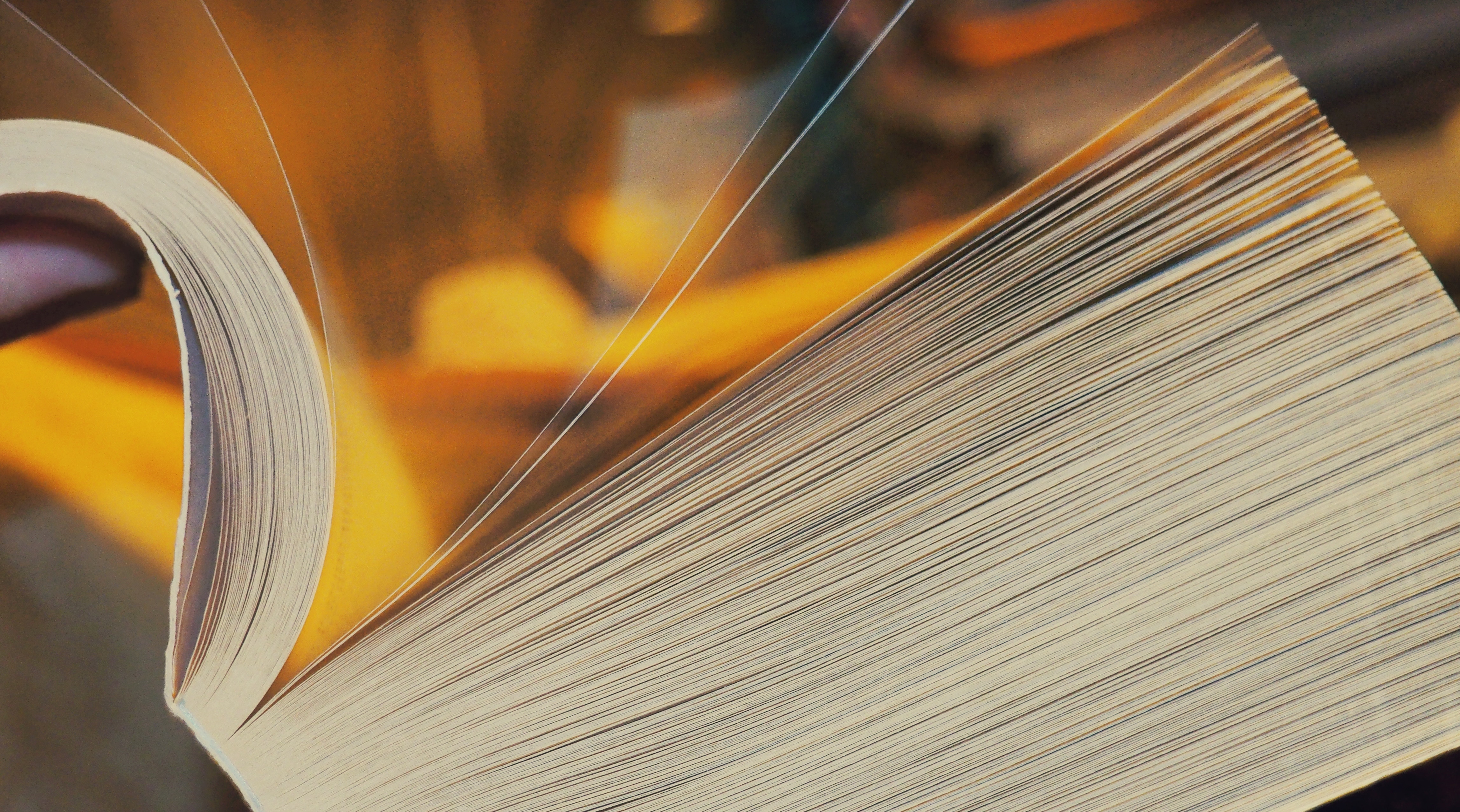
The deckle edge dates back to a time when you used to need a knife to read a book. Those rough edges simulate the look of pages that have been sliced open by the reader. The printing happened on large sheets of paper which were then folded into rectangles the size of the finished pages and bound. The reader then sliced open the folds.
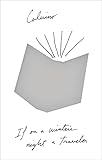
Paper knives, variants of letter openers, were used for this purpose. Italo Calvino’s If on a Winter’s Night a Traveler, which speaks directly to the reader and describes the reader’s experience reading the novel, makes extensive reference to these literary knives:
This volume’s pages are uncut: a first obstacle opposing your impatience. Armed with a good paper knife, you prepare to penetrate its secrets. With a determined slash you cut your way between the title page and the beginning of the first chapter.
Opening a book can already feel like opening a gift. Armed with a knife and freeing the pages and the story hidden beneath the folds, it becomes something more, “a penetration of its secrets” and an act of discovery, shot through with a suggestion of violence and danger or of the painful gestation of the words themselves.
This act of cutting open pages to read a book has been lost (one imagines the paper knife arrangement wouldn’t go over well with the TSA), and right now, all over the world, people are reading their books on screens and the idea of even opening a cover and turning pages may one day seem odd as well.
This idea of the book as an anachronism may explain the persistence of the deckle edge, which is now created not by the reader with a knife but by leaving one edge of the page untrimmed during the printing and binding process.
Peggy Samedi, an associate production manager, told me that at Knopf where she works the deckle edge is part of the publisher’s “house style” along with certain other flourishes and fonts. It is typically used for more literary-oriented books and they see it as “something that harkens back to an older way.” It rises from the idea, she says, that “not everything has to be smooth and slick.”
Nonetheless, the production department at Knopf regularly fields calls from readers who complain about the ragged edges, assuming they are a mistake.
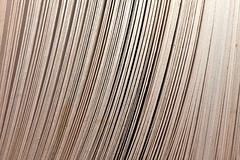
If you look closely at a deckle edge, even if you are looking at two copies of the same book, you’ll see slight variations in the edges. And from title to title and publisher to publisher, the quality and pattern of the edges varies more extensively, from a tight saw-tooth, when looking from the top of the book down the edge of the pages, to a more free-form ragged look. The deckle edge varies, not because it is made by hand, but because the machinery for making books varies slightly from factory to factory.
Perhaps this deckle edge is a way for publishers to prepare for the inevitable. As ebooks and ereaders contrive to make the reading process as simple as pushing a button, physical books will regress to older and older forms, so as to appeal more to the antiquated among us who still prefer them to their digital doppelgangers. Deckle-edges will prevail, uncut pages will re-emerge, embossing will become more elaborate.
In time it will be said, to own a book is to be a purist, and these are the books that purists will prefer.
[Image credit: Horia Varlan]
at 10:13 am on February 5, 2010
Timely, Max (for me, anyway). I just bought a handsome edition of Balzac for six bucks at the Strand…one of those old 1930s jobs where the print sort of stands up from the page.
Only problem? My Balzac is…er…uncut.
Does anyone know where I can procure a book knife, or what I might substitute, and what the proper technique (angle, force, etc.) for ‘cising those pages is?
Thanks!
at 9:09 pm on February 5, 2010
I’ve long found deckled edges to be a pretension, as unpractical for people who actually wish to read and consult a book as those unopened pages from centuries past.
My experience with opening those pages is that the important thing is to have a reasonably sharp blade and to keep it moving at a slant to the page, not straight up into the fold.
at 4:31 pm on February 6, 2010
I LOVE coming across uncut pages. There’s something truly magical about having to slit open pages to be the very first person to see them. When I’m looking at old books in the John Rylands Special Collections Library here in Manchester, I come across them occasionally and have to take them to the desk to have them cut open. I do wish books were still printed this way.
at 2:35 am on February 7, 2010
Max, a very nice article. Certainly the talk of the book’s demise has made many of us revisit high points and memories of the stages of the books evolution. For me it seems like books will become prized artifacts, perhaps persisting as “special editions” or collector’s pieces. I don’t think the book will survive the transition to electronic delivery, because the very nature of the book dissolves and we’re left with text, freed of exactly the physical constraints that created the bundles of bound leaves we came to call “book.”
By the way, it was always my impression that deckle-edged paper was made by using the edge of the large paper sheets, where the pulp thinned at the edges, and leaving those edges uncut. The variation in the deckling is from the vagaries of the pulp coalescing into the drying sheet of paper.
at 9:07 am on February 7, 2010
Joel, you may be right, I’m certainly a novice when it comes to the specifics of book making. What I gather is that the deckle edge is made in the way you describe – as I wrote “by leaving one edge of the page untrimmed during the printing and binding process.” But that it is a visual stand in for the idea of pages that have been cut and for “oldness” in general.
at 9:22 am on February 8, 2010
“the peculiar few who fetishize [books] as objects”?
I think there are quite a lot of people out there (though probably peculiar, aren’t we all) who love books not because they are merely objects, but because they are objects that, once read, become more than objects–books become imbued with the emotions and history of the reader.
That’s why we put a book, once read (if we cared for it), on a shelf, and why, when we move, we cart that book around in a cardboard box until a new shelf is found. Books we love are attached to us by invisible threads, are a part of our autobiographies, and are not easily cast aside.
Peculiar? Yes, humans are! Uncommon? Naaaaah.
at 10:25 am on February 8, 2010
I’m a book fetishist who dislikes the deckle edge — I’m screwed!
This is hilarious: “…the production department at Knopf regularly fields calls from readers who complain about the ragged edges, assuming they are a mistake.”
at 11:47 am on February 8, 2010
@Philip Graham: very nicely said and I agree that books ‘become imbued with the emotions and history of the reade’ once read.
And think this is why e-books (very good for traveling light) will never fully replace real books.
My book collection is made up of old friends.
at 11:57 am on February 8, 2010
Thanks, anechoic–there’s a great post you might want to read, by Levi Stahl from his website Ivebeenreadinglately, about the power of books in both physical and interior space, “Books did furnish a room”:
http://ivebeenreadinglately.blogspot.com/2010/02/books-did-furnish-room.html
at 1:11 pm on February 8, 2010
Having all books uncut when purchasing them would be a great way of keeping track of what’s still unread…
Imagine the feeling of happy anticipation when looking at rows of uncut books with your retirement coming up!
at 1:37 pm on February 8, 2010
I think you’ve confused ‘uncut’ and ‘unopened.’ Opening is the cutting/tearing of the signature’s folds. An opened but uncut book would have the rough, uneven edges that (as you describe) are sometimes imitated today on purpose. One might, after opening, have the edges trimmed — this would be a book that was cut — so the edges would be similar to those in modern books. I suppose this all harks back to the days when a bookseller sold just the printed signatures, and the customer had them bound to his or her own taste.
This all sounds very old-fashioned, but as recently as when I was a student (a mere 35 years or so back), I remember buying books from French publishers that came unopened (and hence also uncut).
at 1:40 pm on February 8, 2010
Thanks for the clarification J. I figured there would be some corrections to my terminology. I’m not as well versed in the book-making lingo as some folks.
at 2:13 pm on February 8, 2010
I can’t even tell you how much I despise deckle edges. Like French flaps, they make the book so much more awkward to read (particularly if it’s a thin volume). I will often avoid an otherwise excellent edition of a book and purchase a different one instead so I don’t have to deal with them.
at 6:08 pm on February 8, 2010
maybe all those flourishes have come about because people would be hard pressed to pony up so much money for a hardback version of a book they’ve been waiting to read and will take only a few hours to plow through.
i go to the library and buy the occasional paperback. hardback books have been priced out of my middle-class standard of living. i have, however, hung on to my college textbooks and the nonfiction hardbacks i’ve purchased over the years. they’re sacred texts.
at 6:19 pm on February 8, 2010
From _A new introduction to bibliography_ (Gaskell), page 61: ‘The outer edges of the sheet — the deckle edges — are rough and uneven where the stuff ['stuff' is what paper is made from] seeped between the deckle and the mould.’
Sounds like back in the old days sheets of paper had deckle edges naturally — that roughness wasn’t from cutting the pages open, necessarily.
Whether fake deckle edges on Knopf books (for example) are imitating the rough edges of handmade paper or the torn edges of hand-cut signatures, I’m not sure. It doesn’t matter: either way it’s an affectation that looks silly and makes a book less useful. Don’t confuse this kind of frippery with thoughtful, honest, high-quality book production (of which there is almost none in the USA currently, at least at any scale).
Knopf and others should wise-up and realize that they’re producing tacky stuff (which people like the writer of this article are nonetheless fooled into thinking is somehow ‘pure’ [it's just the opposite!] and admirable). These are twee, shoddy parodies of books. If you want to see what form honest & well-considered contemporary books could take, buy something published by Hyphen Press (for example) and then inspect it very closely — you don’t even have to read it. Compare it to a recent Knopf hardback and begin to see how you’ve been fooling yourself.
at 7:03 pm on February 8, 2010
The part about Knopf getting complaints from people who think deckle edges are a flaw makes me laugh. I almost wouldn’t believe it but a food blog I read every once in a while recently spawned a book with deckle edges, and at the time I was stunned to see that several commentators there also complained about receiving what they thought was a flawed copy. I’m inclined to agree with the commentator above who sees them as an affectation, and I wonder if it isn’t possible that deckle edges are disproportionately being put on books intended for people who don’t buy books very often.
at 8:35 pm on February 8, 2010
Great article. I hadn’t really thought about deckle edges until I saw a description of them on Amazon for certain books, advertising them as a special feature. Maybe they are advertising it so people don’t send them back, mistaking them as damaged!
at 5:24 am on February 9, 2010
See Gatsby’s library.
at 2:30 pm on February 9, 2010
Mixed feelings about modern deckle edges. I have a subconscious feeling that they go with a “specialty” book, old books.
I do also recall in the 60’s buying some books in Spanish from one publisher in Spain in which the pages were uncut. It was a bit annoying then to have to read with scissors or letter opener in hand (either worked.) The paper was heavy, even though the books were paperbound.
But at least, when occasionally coming across a reference in 19th cent. fiction to a book with uncut pages, I knew what they were talking about.
Probably wouldn’t want to bother with it today; OTOH, if publishers leaving pages uncut meant lower prices, I might be willing.
at 11:23 pm on February 9, 2010
[...] At The Millions – C. Max Magee waxes aesthetic (and perhaps nostalgic) on deckle-edge pages. [...]
at 9:28 pm on February 10, 2010
Those above who decry inauthenticity of modern deckle edges might like to consider that the idea of authenticity is quite problematic.
An example: modern hardback books are bound in dark red leather or cloth that is the same colour, meant to imitate the dark leather. Back when book lovers bought unbound signatures and had them bound themselves, the preferred binding was a nice light-coloured pigskin. Over the years the binding of an old book would darken to the now-familiar russet.
So when you buy a leather-bound book of a dark hue now, you are buying something that is pre-aged to look like a pigskin book you have owned for many years; and when you buy a dark red cloth-bound book you are buying an imitation of that.
at 10:41 am on February 11, 2010
[...] I never knew there was a name specifically for the edges of uncut book pages. [...]
at 4:27 pm on February 11, 2010
Viveka Weiley says we ought to consider that ‘the idea of authenticity [in book production] is quite problematic’, going on to give an example about modern hardback books having a coloring that’s imitative of worn leather.
First, I don’t think authenticity comes into it. It’s not a helpful word here. The contention is that the fake deckle edges are useless affectations that make the book harder to use (because it’s harder to thumb the fore-edge of the book block). Not that they make the books less ‘authentic’. We’re interested in honesty, simplicity, functionality, and modern high-quality production. ‘Authenticity’ or the lack thereof has no place in the discussion.
All that said, your example doesn’t help your (ponderous) case. I wouldn’t want to buy contemporary leather-bound books ‘of a dark hue’ (it’s a waste of materials and money, totally unnecessary), just as I wouldn’t want to buy a book with a fake deckle edge. Your example only compounds the larger point that most book manufacturers are producing schlocky stuff these days.
So I don’t see how ‘the idea of authenticity is problematic’, as it’s besides the point. None of the other things I’m arguing against pose problems of understanding either — they’re all pretty obvious once you stop to look at some examples of how books _could_ be and then compare them against what you’ve got with 99% of trade books in the USA in 2010.
at 12:03 pm on February 12, 2010
[...] Deckle Edge in the Age of Mechanical Reproduction: "The deckle edge dates back to a time when you used to need a knife to read a book. Those rough edges simulate the look of pages that have been sliced open by the reader. The printing happened on large sheets of paper which were then folded into rectangles the size of the finished pages and bound. The reader then sliced open the folds. Paper knives, variants of letter openers, were used for this purpose." [...]
at 11:01 am on February 16, 2010
i also bought a set of balzac, for something less than a dollar a volume, and i had to cut open the edges. A typical letter opener does the job.
at 11:41 am on February 18, 2010
Isn’t there a very practical reason for deckled edges? In these days, when the large book store chains allow customers to thumb through books to their hearts content without buying them, or to return books for a refund (and resale by the bookseller), deckled edges are far less likely to show ‘use” than straitght edges. So I assume that publishers use them for very practical, economic reasons.
at 11:30 am on March 4, 2010
I love books that have deckle-edge pages. I find such books much more inviting to read. I look forward to Knopf hardcovers because of the deckle edges, the note at the end of the book about the typeface used, and the changing appearance of the borzoi logo (to suit the book and book cover design).
Yes, deckle edges do help to hide/disguise finger dirt & oils. Also, the cut edges of the text block used to be dyed/tinted/colored — again to foil dirt/dust damage. I remember the edges of Avon paperbacks being dyed red, and the edges of Ballantine paperbacks being dyed a deep yellow. Different publishers used different colors. All this seems to be gone now. I miss it.
at 12:59 am on March 5, 2010
[...] Amazon/Macmillan ebook pricing catfight has you longing for a simpler time, look no further than this ode to the deckle edge on The Millions: Opening a book can already feel like opening a gift. Armed with a knife and [...]
A Year in Reading 2009, 2008, 2007, 2006, 2005
Best of the Millennium; Readers' List
A new way to browse The Millions! Books and Reviews
Bookmark these links to stay on top of the hottest books:
Hot 100 | Awards | Movers & Shakers | Bargain Books | Kindle Bestsellers
More From Books as Objects
More From Notable Articles
Other Recent Articles
Recent Comments
2009, 2008, 2007, 2006, 2005
Readers' List
© Mmix The Millions. Some rights reserved. This work is licensed under a cc attribution-noncommercial-Sharealike 2.5 License.